
Brake shoes – A sticky problem resolved
So, you are driving up a trial section, dab the footbrake which acts only on the rear brakes and the car slows but then stops even with your foot off the brake
Start to think which part of the car has taken it’s turn to break this time, blame the passenger then slide the car backwards off the section so that other VSCC members in their Bugatti’s and Bentleys can sail serenely by
Inspection reveals that one rear brake has jammed on and because the cam that expands the brake shoes has gone over centre and not returned
A healthy tap with a convenient stone restored the cam to its normal position and we proceeded on our way trying not to touch the footbrake
This situation arose due to adjusting up the brakes to compensate for the large amount of wear induced by trying to avoid ramming into the back of an expensive Range Rover which was towing us 6 miles out of Ryader forest after another breakdown on a previous trial.
I had not realised that this could happen and I should have relined the brake and not just shortened the cables
After removing the brake drums I found that the shoes were well worn but not down to the rivets as there were no rivets since they were bonded shoes
Not having the time to get new linings bonded on, with zero ability to set rivets and being keen to get the rest of the wear out of the linings I decided to modify the steel anvil on which the cam bears at one end of the shoe
I wanted a shoe spring remover as described in the club mag by Ian Moorcraft since I too have suffered from cut and bruised fingers from trying to remove shoes using a hook or wire on the springs, not to mention the bad temper and being driven to drink
For some reason this excellent gadget is not available from stock in my local engineering suppliers, the middle of Lidl. Also, like some complex cooking recipe in the Sunday supplements, I did not have the main ingredient “Take a length of 3/16” bar” as it is not commonly needed in veterinary practice. However, I did have some 8mm studding left over from an orthopaedic op and a few minutes work with my trustyangle grinder soon reduced it to 3/16.
This imperial measurement produced another problem as I had to convert all of Ian’s measurements to metric for my metric drills.
I did eventually manage to do this by remembering my primary school maths and cheating with the calculator on my phone. This is something that the American space engineers failed to manage when their satellite flew way past Mars after they failed to convert imperial to metric measurements correctly
(Personally I blame the careless Frenchman who was carrying a metric standard, developed after the French revolution, from France to North America as his boat sank on the way carrying him and his standard to the murky depths)
The old piece of steel on the shoe was carefully cut through and the central fixing stub of ally filed back to give a flat area
This was then drilled and tapped to allow the fitting of a 3mm countersunk screw to hold on a new piece of thicker steel.
The ends of the steel were bent back along the shoe to help secure it
This system allows different thicknesses of steel to be used to take up the wear in the linings
In order to reduce wear on the steel ensure that the edge of the brake cam has been rounded off
Those of you who keep up with the Austin 7 literature will no doubt have seen mention of fitting extra steel around the fulcrum at the opposite end of the brake shoe (ref Bodger, Bungler and Bodgit et al) Since this alters the radius of the fulcrum, I cannot see how the shoe can then seat properly
Overall, this system allows the use of soft, grippy bonded linings and get the full value out of them, but you do need the magic IM tool
Thanks to Friction Services, Keynsham for the linings
That’s K E Y N S H A M to those of you who used to sneak one of those new transistor radios under the bedclothes to listen to Radio Luxemburg at night
(If you don’t get the reference ask your grandparents)
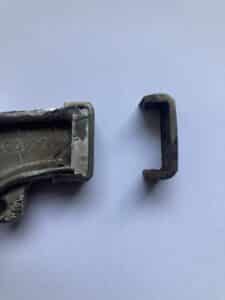
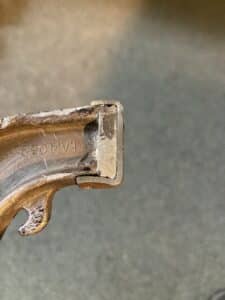
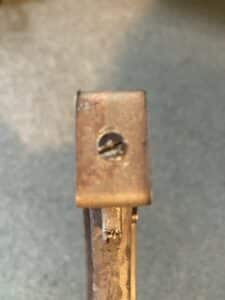
2 sizes of steel caps or anvils Cap fitted to brake shoe End view of cap